I have recently learned that some people only partially fill their petrol tank in their car to save money by not carting around the extra fuel. While I understand the theory, I didn’t think it would make a measurable impact on the fuel economy. So I have now done a calculation with some assumptions to see how much you would save.
Rolling resistance changes with speed, weight, road conditions, tyre pressure etc. I’ll add a fixed 10% for simplicity.
Wind resistance doesn’t affect mass acceleration so is ignored.
Hills are ignored as the energy is recovered on the downhill.
As we are looking at only the increased mass of the fuel being transported we can ignore the mass of the vehicle.
Fuel efficiency of a car on the road today is 20-40% (except maybe a rotary which would be below this and a hybrid which could have a higher efficiency). I will use 35% as a starting point.
The biggest component of fuel usage on the mass of the vehicle would be acceleration of that mass, so that will be the calculated variable.
Acceleration rate is ignored, but does play a factor in reality, as the harder you accelerate the less fuel efficient the car is.
Using a speed limit of 60km/h is because that is where most stop/starts would be occurring where energy is needed to accelerate the extra mass of the full tank. I would assume when accelerating to 70 km/h + there would be fewer stops so acceleration of the fuel mass is not a high consequence when taking in to account wind resistance.
My wife does a school run and that is 12km with 10-14 stops depending on traffic. Assuming a fuel economy of 8L/100 this equates to ((100/12)*12)/8=12.5 stops per L
Assuming a 60L tank of a sedan and petrol price of $2/L
KE=1/2mv^2 where
KE= kinetic energy in Joules
m=mass in kg
v= velocity in m/s
Density of petroleum =745kg/m^3
Energy density of petroleum =46.7MJ/kg or 36.1MJ/L or 10KWh/L
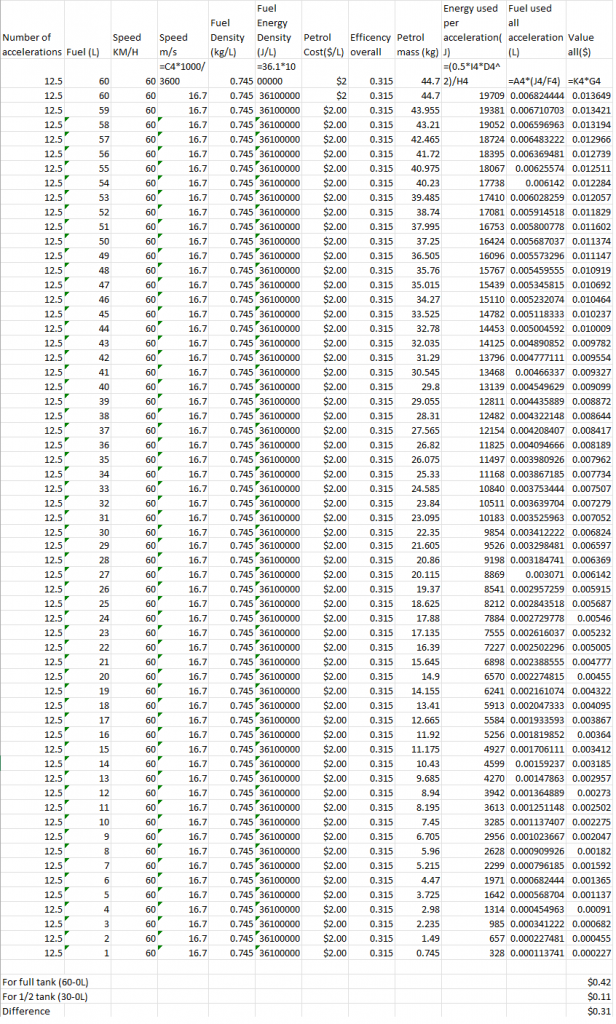
I will upload the spreadsheet of the calculations done at 1L steps but the cost of driving the fuel in your tank until it is empty is:-
For a full tank 60-0L=$0.42
For 1/2 tank 30-0L=$0.11
This means the difference in cost of filling the tank vs 1/2 filling the tank is $0.31. Depending on how you value your time you might want to save this money for the extra effort of visiting a petrol station more than twice as often, as in reality you can’t let the tank become completely empty, so you would be refilling it before that point and the cost saving becomes worse.